
Designing an agent that learns you, and building the app it lives in.
Raven is your personal AI guide for the electronic music scene. It knows the scene, learns your taste, and tells you which nights are yours, like a friend who's always out. It launched in the US App Store in September 2026, New York first.
Role AI Product Designer and Builder (contract) · Timeline May 2026, ongoing · Platform iOS · Built with React Native and Expo, a Node agent server, Supabase, Gemini, Claude Code
The app at askraven.app →Where Raven started
When I joined, Raven was a working web app with real users. It asked onboarding questions to build a taste profile, but personalization wasn't really working. A chat had been tried, but a chatbot isn't an agent. So in the end you used filters to find events that matched your vibe, and filters leave the choice to you. For someone deep in the scene, the choice is the whole job.
We redefined the core product and its main job: a personal agent that knows the scene, learns your taste, and tells you which nights are yours. The first thing we rebuilt, in May, was the core data it reads from and writes back to: your profile and the events. Everything else is built on it.
From there, my work split in two: designing how the agent learns your taste and vibe over time, and building the app it lives in.
My role
We're a team of three. Our founder and CEO owns the vision and the data pipeline. Our UI/UX and brand designer owns the app's look and experience.
Designing the agent experience. The agent is where the work splits: our designer does its UI, and I own the experience inside it. What it does, how it talks, what it remembers, and the feedback and interactions around it.
Developing my first iOS app. I own the development end to end with Claude Code. I build the app and the agent server behind it, and I set up the environments and the shared workspace. Because I build the system that holds the design, it doesn't get lost in a handoff, and what must always hold is tested in code.
Some of the work is overlapping and as a small team we define and decide together a lot on how things should look, feel and behave.
Voice, and the bake-off
Conversation design is part of designing the agent experience. Tone of voice is a big part of it, though not all of it, and it's where someone decides in two lines whether this thing gets them.
Raven sounds like a friend who was just there. To understand how to make it sound like this and to use the right terms to describe a party, a genre or an artist, I researched through different social media channels, rave bloggers, and electronic music sites.
“Kush Jones and MoMA Ready in the Basement” says more than “heavy, dark, intimate.”
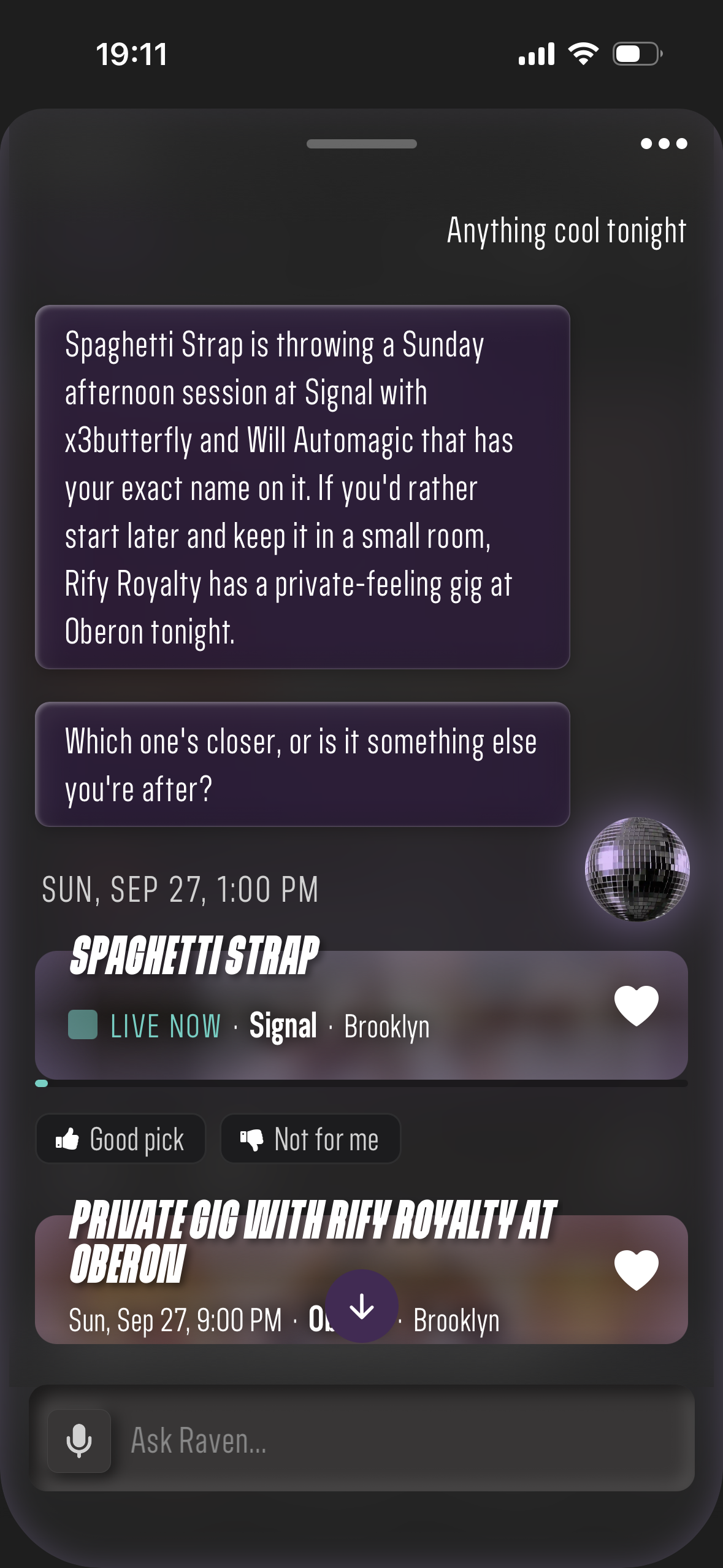
To choose the model, I ran a bake-off: four models, our real prompt, the same scenarios, compared on voice and on whether a conversation held together over several turns. I chose Gemini because it gave the best answers, in tone of voice and in structure.
The tone keeps getting refined. I grade dozens of conversations myself, across different types of scenarios, and in parallel I give our founder a selection to grade, because she lives the scene in NYC.
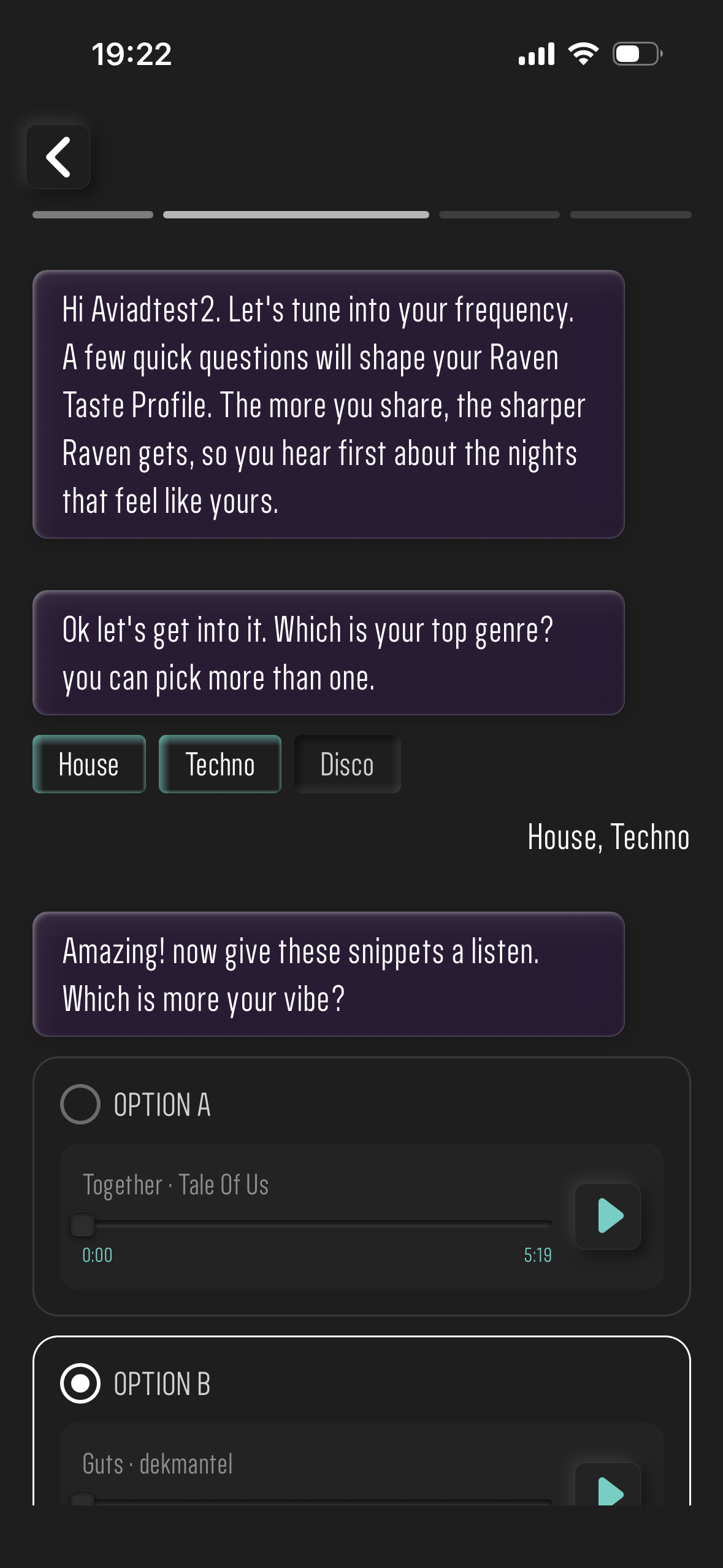
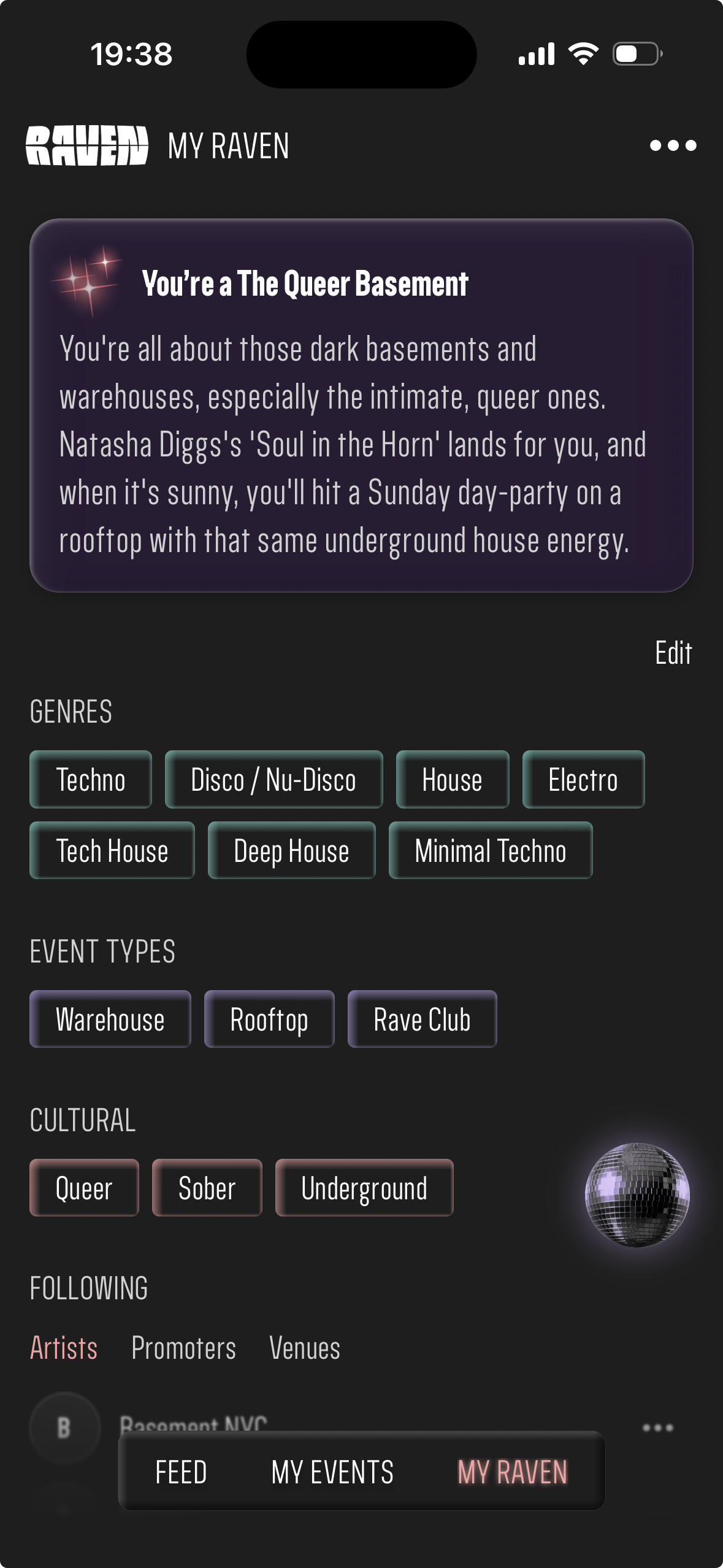
Inside: how it recommends, how it learns you, the harness, the build, and how I measure it.
No password? Ask me